Monday, 13 October 2008

Stumbling home


As I wandered the streets, my head weighed down with the water I refused to let well and fall from me, I stumbled and almost fell into the road. I sat and wondered how it would have felt to have been squashed by a truck or a bus. I couldn’t imagine it.
Wiping my running nose with my sleeve, I remember staggering on through the open market of St Christian’s. I wouldn’t cry in the street. The market stalls all lay bare and plastic bags swirled about my legs. It was Sunday, so I knew where she’d be.
I hadn’t thought about her in days. The economy of mind can help you get through life without any real thought muddying things. It helps you do your job, it helps you get up in the morning.
But yesterday I heard a flute playing quietly, a low soothing melody drifting up to me. It haunted me like a spiralling devil and I drifted down the hole that I’d been long digging but never fully explored.
I spent all afternoon in the company of red wine and the piano. Satie’s Gnossiennes coloured my day and I swear the music of the flute came through strongly every now and then, an accompaniment to my thoughts and my ever flowing fingers.
The fug hasn’t lifted since then.
I remember her chastisement on the last day we spent together, but I don’t want to recall why she scolded me so. Thomas watched me go past his open door via the mirror in his bedroom. She told me not to say goodbye to him. I could see the reflection of his red eyes blinking, though. He wrote and told me that he’d never felt a sound like the sound of my closing the front door that last time.
So here I am. I’ve almost stumbled home. Thomas likes to come to The Castle Courtyard where they put a play on every week. The theatre is always on after his bedtime, but Marie-Élise will take him to see a rehearsal, or just to witness the stage hands preparing the props and the lighting and the sets. Thomas can watch their performance for hours.
He started to clap when they lowered the chandelier from the rafters. It must have seemed like magic to him. And when two people walked by he stood on his chair so that he could still see the stage, just in case he missed anything. His mother held his hand, so he wouldn’t fall.
I ducked back behind the pillar then. I couldn’t hold myself upright any longer, hold myself in. I sank to the ground, biting at my lip, clawing at my hair. I heard the squeak of a bicycle wheel and shuffled around, away from the oncoming steps of my wife and child.
Once I was sure they were gone, I raised myself and took the seat she’d taken. I sat then and watched the men as they finished dressing the stage; applauding and weeping at their every flourish, their every measured placement of cloth or curtain, long, long into the burnished night.

Friday, 10 October 2008

The glutinous tide


The strange giddy essence of summer has been long spent. I’m back to my beach now, back to reality.
How hateful it was to see Anne once more. It was as if, in exile from her, on the sunny south coast, she floated in a bubble of perfection, colouring every image that invaded my head. Then, once my eyes were confronted with the truth of her image, they were suitably repulsed. How her features hang from her face, how her bones seem to sag. I kissed her goodbye on her pallid cheek and headed for the beach.
This is a beach, this is a real beach. No streams and golden sand, no bikinis and balls, no surfers and no tanning crowds – just a miraculous red-brown slop, as far as the eye can see.
Who knows where the sand stops and the tide begins? None would dare walk out on it for fear of being sucked down beneath the cloying mud.
That’s what I’ve come to appreciate now. I don’t need the beauty of the blue sky and the miles of pristine beach. Give me a dangerous, windswept, miraculous, mudpool any day. Give me something that will swallow me up in its bleak glutinous tide any day of the week.
Give me Sylvie.

Thursday, 9 October 2008

The stare and the portrait


“Do you see the way he stares? It's unnerving”
“I wonder if he has any hands?”
“What might be the significance of the wine bottle?”
The photographer moved about the exhibition silently, dodging guests munching canapes and sipping champagne. He barely brushed their suits nor crushed the silk of their dresses as he wafted by without recognition.
It wasn't that he was unknown in the industry, it was just that these people, this assembled throng of monied patrons had sniffed the scent of 'the next big thing', of 'a sound investment'. They didn't care whom the artist was; the name was unimportant until it truly carried value. At the moment his name was simply spelled: 'Potential'.
You might ask why the photographer himself was even there. He asked, but the curator just tugged at his arm in an over-familiar manner and said: “Oh come now, Baker, I need you there as the deal clincher... if anybody's wobbling on a sale, I bring you in to charm them into the bag.”
So far he hadn't been called into action to perform his reverse snake-charming trick. The gallery had already made four sales, with the minimum of fuss. A red sticker against the glass frame of the large black and white prints gave that away.
All the sales so far had been of landscapes. They were an easy sell. But the portraits, now there's a different matter. How does one convince another that a portrait of somebody they've never met before, and likely never will, should hang forever more in some corner of their home – and that they should pay close to a grand for it?
Still, Baker was proudest of his portrait shots and felt driven towards their sale. He drew closer to one of his favourites. He'd called it: 'Neil Young fan, number 02758'. The photograph had been taken earlier that year, during the round of summer music festivals that always draw the strangest of creatures out into the open for their annual glimpse of the sun. Baker had paid the subject £20 for the shot, a price that included a glass of wine, a drunken acapella song and the man's ticket stub for the concert – which gave the image its title.
“Aha,” cried the curator of the gallery, breaking off from his schmoozing of the ravenous guests for a moment. “Here is the artist himself. Mr Baker, I wonder if you couldn't spare a few moments of your precious time to talk to some of our most valued patrons, Mr Baker?”
Baker forced a smile, but it came out flat and barely raised north of his lips. “Good evening, ladies and gentlemen, a pleasure to meet you all,” he said with a slow nod. 'Was that over the top?' he thought to himself – he really couldn't be sure.
“Mr Baker,” piped up one of the women, a plump thing with an expensive face, “I wonder, could you tell us a little about your inspiration for this image?”
“By all means,” he said with another forced smile. Inspiration was something he greatly needed at that moment and he searched through his mind for the name of a photographer to help him out.
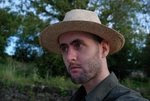
Everyone seemed to lean in as Baker paused to speak. “Er, well, of course, William Egglestone was my primary influence, as I'm sure you can see.” He doubted anyone would be able to see anything other than a man in a hat, sitting on something waterproof. He felt better.
A tall man in a cap and green jacket who looked like he'd spent all day at the races spoke then, a look of scrunched up confusion on his face: “But surely, Mr Baker, Egglestone is known for his documentary of the ordinary, the mundane. I'm sure you'll agree, this subject isn't the sort of pristine, banal capture that Egglestone favours.”
Baker hid his scowl and the grinding of his teeth as best one can when caught out like that and, grabbing a discarded glass of wine from a nearby table, knocked back half the champagne in one before turning upon the man with gusto.
“Of course, you've failed to see past the obvious in this image. Yes, there is a strange young man in the photograph. Somewhere between grainy and pristine, akin to the close portraiture of Robert Frank. But look beyond the man, look deep into the image, at the fragments of canvas and grass and the stink of cheap red wine. That sir, is the hallmark of William Egglestone!”
And with that he polished off the remains of the bubbling vintage he held in his hand, and swept away to a darkened corner of the room. He wondered if perhaps here he could retire from the unceasing and unnerving stare of the punters and just be. Perhaps here he would become unknown and unnoticed once again?
Whatever happened next, he knew it would not last for long.

Wednesday, 8 October 2008

Of sheep and men


The sheep munched lazily on the grass. Hazy viewed afternoon; Jennifer settled down on the grass, a safe distance from the animal.
She didn’t like sheep. She would tell other people that she didn’t like anything which had a plural the same as its singular. This would disarm or amuse the person interrogating her so that they wouldn’t ask why she was scared of fluffy little, wouldn’t hurt a fly, cute and cuddly, sheep. They could walk on by without further questioning.
Now that she sat in this vale, with nobody but her and one sheep for company, she wondered if it was their multitude that scared her. Flocks and sheep are words inextricably linked. It was unusual to find one here, contentedly chewing the long summer grasses, completely alone.
Watching the sheep intently, Jennifer wondered if the two of them hadn’t been led here, by some greater power, to better strengthen the bond between man and sheep. To gain a better understanding of each other and cast off the fear of the unknown.
The sheep, she gathered, needed little. It wished only for grass, which was in plentiful supply. And, when the weather grew cold, a coat of the very finest wool grew heavily across its body.
‘It’s not a bad life for a sheep,’ she thought, completely forgetting where the creature stood in the food chain.
Jennifer hopped up onto her knees and then allowed her bodyweight to shift forward. Her arms reached out and caught the ground before her. Her simulation of life on four legs was simplistic, but it would have to do.
She looked back at the sheep, brushing her long black locks from her face in order to better observe it. The creature bent its neck low and bit at the long green stalks, vacuuming them into its mouth and ruminating upon them with a professional ease.
Jennifer tried it. She found that she really had to grind her teeth together hard and then use all the strength of her neck muscles to help rip the tough grasses free. And then she munched.
The girl stayed in her four-legged pose while she worked the cud round and round in her mouth. It felt like her saliva had become thickened and milky in her mouth. She looked at the ground and noticed the odd fly and beetle hopping across the stalks. Undeterred, she kept on chewing and, when she felt like she could chew no more, she swallowed it all back. It was a strange sensation as the thin blades were sucked down into her gullet and she choked a little before it was all gone. She considered the taste for a moment, but could only place it as ‘grassy’. It seemed like she instantly recognised the taste of grass, though she couldn’t say for sure that she’d eaten it before. ‘Perhaps it’s the same for everyone,’ she mused, as if knowledge of the taste of grass was innate to human beings.
She was dribbling a little onto the ground and when she looked up she saw the sheep across the vale was staring at her, quite obtusely, as if she had no manners whatsoever.
“It’s alright for you,” she called. “You’ve done it all your life, I’m new to all this grass malarkey!” And with that she sat back down on her bottom, scowling at the sheep, and wiped her face with the back of her hand, smearing her cheek green.
The sheep looked away, nonchalantly as you like, and moved a little closer to the river where the grass is even lusher.

Tuesday, 7 October 2008

Salvatore and the gardener


Every morning, Salvatore crept up to the gateway of the Villa Fredo and peered inside, to see if the gardener was there.
In the mock elegance of the courtyard, its owner, M. Laroute, had created something akin to the famous Moorish palace of Alhambra in Southern Spain. M. Laroute had never visited Granada, but his gardener had.
His gardener liked to say that he had travelled to every continent of the globe, and that every single wonder that he had seen on his travels remained fresher in his mind than any shimmering painting or photograph, and far more fantastic and wonderful than any story you may care to tell about them.
On the mornings when Salvatore could find the gardener, he was greeted by a kindly smile, a funny joke and perhaps one of the oranges growing in the garden. Sometimes Salvatore would ask the gardener his name, but he would always reply the same: “You have no need of names when you grow as old as me.”
If pushed he might add: “When something is very old, Salvatore, it can’t remember its given name any longer and it just has to accept the new names it receives with grace and gratitude.”
And, if pushed further still, he might say: “Child, just ask the ground beneath you. It has so many names now, it has forgotten which came first, but it accepts each new title just as it accepts those who walk upon it without the merest consideration of its great and very ancient beauty.”
When Salvatore pushed and prodded the gardener this much, he knew a tale was not very far away. A tale of lands so distant, they might as well be the pinpoint lights of stars. And the people and the creatures that might inhabit these lost places… Oh, the wonder.
But this morning the gardener was busy tending the vines and trellises that adorned the arched walls and Salvatore knew there would be no time for a story today. “I’m sorry, boy,” said the gardener, “but I am doing the master’s work today. It’s not blasphemy to offer God a little helping hand making the flowers grow now, is it?”
So Salvatore ran along to school, and there he studied great books and was shown many images of the marvels of the Earth. But as the other children cooed and were amazed by what their teacher showed them, Salvatore couldn’t help but think that they paled in comparison with the wonders that lay inside his gardener’s mind. Lost, and impatient to explore, he spent most of the day imagining what amazing secrets still lay undiscovered there.

Monday, 6 October 2008

Perceptions


Drinking with people after work. A potential nightmare. I made sure I found my way into the bar about 20 minutes later than we’d all agreed to meet. It wasn’t in order to make a grand entrance, rather to avoid those early awkwardnesses in a night out with people who aren’t friends.
Still, who to sit by? There wasn’t much choice. I knew Liza a little, and Casper too. Jane looked very sexy, but completely out of my league.
There was a space next to Casper on the corner of the table. It seemed a safe option so I said a group hello (giving an exaggerated wave), threw my coat in the space and offered to buy drinks – thinking everyone would already have one and so not take up my offer. It’s easy to get shot down by fast drinkers, though; both Steve and Todd were just draining their first pints. They were Americans and surprisingly adept at drinking for men more used to the likes of Budweiser than European ales.
I ordered up a couple of Heinekens for them and opted for a smoother pilsner called SD Haagens which I’d tried on my first visit to this bar, back during my first week in Milan.
Skilfully carrying the three full pints to the table I was further annoyed to find a shifting of personnel and that Casper had moved along to allow a fellow latecomer, Mandy, to sit down.
Everyone now was facing away from me. There seemed no chance of entry to any of these small whirls of conversation. Instead, I surveyed the group.
What a strange mob they were: a ragged and tousled group of dissidents, drawn from across Europe and America to work for a faceless multi-national, in the beating heart of Northern Italy. I’d been here three months now, and I’d seen little of the place except the inside of bars, the sunlit vistas from our plush office windows and the sickly pixel glow from my eternal monitor screen.
Something Mandy said had caught my attention. A word, or a name – something that interested my mind. I turned my face towards hers. Almost inexplicably for a member of this group, Mandy wasn’t drinking. She was a plain, boring woman who must have been close to retirement age. She was talking across the table to Jane. Her voice resounded with monotony but I listened in. There was really nothing else to do.
She was talking about music and I was surprised to hear her say that she had been a bit of a hanger-on during the burgeoning pop scene of swinging London, back in the 1960s. She mentioned meeting a few individuals whose names I half-recognised. Jane nodded blankly as she reeled them off.
With a smirk, I cheekily interjected and asked if she’d once been a groupie. She turned towards me, her face quite placid, and explained that she had enjoyed a rather torrid, short-lived affair, with the folk-pop star, Donovan.
I tried to hide my sudden interest in her, but, this woman had just changed in an instant. My perception of her was completely altered and I felt for a second that I could look through the lines by her eyes and the folds of her chin and see the brown headed temptress in a mini-skirt she once was.
Maybe she wasn’t even as old as I’d first thought? When I looked at her from then on, my eyes took ten years off her face, her figure appeared more svelte, and her voice, once monotonous, now chimed with the soft stroke of an acoustic guitar.
I’m an idiot, I know. How can something so distant, so removed from myself, as the person somebody used to be, forty years ago, make me find them interesting and, perhaps, even attractive?
A few hours later (as the Milanese were just themselves getting ready to go out) the group began to say its goodbyes and I walked Mandy and Jane to the nearby tram stop.
I kissed each goodbye, and tried to ascertain which woman's touch made my pulse race the quickest.
Walking away, I allowed myself the slightest of turns to glance back at the two women who had entranced me most in these few short months since I’d arrived in Italy.
It was strange where my life had led me, and where my lusts had flown. As I trudged home I tried to work out why I was doing this. Of all the women I’d met in this city of dreams I’d become transfixed with touching the two women who would surely remain forever out of reach.
I seemed to get a strange sense of satisfaction at that moment. To think I was doing this to myself, once again.
There existed then, a tangible sense of excitement in the city and in me. Excitement about the mundane, about going to work the next day, even.
Surely, I mused, this is what life's all about?

Friday, 3 October 2008

Once an angel


As he sat in the field with all the other revellers, Matt’s little heart was breaking. He kept up the pretence of having fun; he smiled and smoked, drank, danced and sang. But inside he was sodden. A mess of man.
A man, you see, that’s all he was and that’s why he was so forlorn. Just that day, he’d realised that he wasn’t an angel.
Matt hadn’t believed he was an angel all of his life, though there were times as a child when he’d looked to the heavens and felt a kinship with the clouds, while the songs of birds and the music of harp or choir had always caused his heart to skip.
All of this combined at the age of fifteen to first make him question whom exactly he was. All of that, and the fact that he fell from a third storey balcony, three days after his fifteenth birthday and walked away with barely a scratch or bruise. ‘Maybe you’re immortal?’ teased his schoolfriends. ‘Or, maybe I’m an angel?’ – he pondered this thought for too long. It seemed a real possibility, to him. When one comes into real danger, when a life is genuinely threatened, one can react with a freshness of consciousness: with an intimate second to second awareness that the next move could be your last. It can change a person.
Still, Matt was always able to keep this aspect of himself hidden. He didn’t ‘seek’ his divine self. He felt that rather obtuse, and that his radiance would ultimately be ‘revealed’ to him and even to others. Perhaps this would be a slow process, or perhaps he would become transfigured one night in the pub? It was something to consider, anyway.
It has to be said that little else of any heavenly consequence touched Matt’s life until his camping trip to a music festival in the English hill country known as The Lake District. For there, by the vast stretch of Coniston Water, he came back to his mind and found himself strolling with the misty dawn. He had been awake all night, revelling. The stony beach gave him a silent place to settle and relax his body in preparation for sleep. When there, standing over the just lit waters of the lake, he saw a devil watching him. It’s grey lace wings were moth-bitten and haggard, but they flickered like a mosquito’s.
The demon’s thick black tail was coiled around its legs, but it sprang to life, arching and threatening as the fallen angel began to walk with purpose towards Matt. It drew forth clawed hands and unclenched a mouth of fangs. The unnameable wretch wished for battle.
And so Matt fled. Turned from the beast and scrambled up the beach in terror. And as he ran he heard laughing, chiding voices in his head: “You’re no angel! You’re nothing!” These demons howled their derision and Matt ran, sobbing, tripping over roots and guy ropes, collapsing miserably into his broken and sagging tent.
By the evening he’d slept and stopped shaking. He took a beer and smoked a joint. The voices had left him now, but he’d turned away and he could barely face what that meant.
Matt looked around at his close friends, gathered in a loose circle nearby. “I’m just like them now.” That’s all he could think.